
Jason Palmer and Rixt van der Valk
I was shocked to find that a single new home submitted for planning recently with ostensibly green credentials had embodied carbon emissions (from the energy used to make and transport building materials) around 500 times higher than the annual emissions from energy use in the home. My calculations suggested it would take about five centuries for ongoing ‘operational’ emissions to reach the same level as up-front embodied carbon emissions.
In the UK, energy efficiency has been written into National Building Regulations since 1965 [1], with minimum requirements ratcheting up every few years so that – broadly – newer buildings are more energy efficient and have lower in-use carbon emissions. This means that developers, designers, and builders have faced a mandatory requirement to consider in-use carbon emissions for nearly six decades. But Building Regulations remain silent about embodied carbon, even though embodied carbon can be as much as 40-70% of a building’s whole-life carbon [2].
This blind spot means that decisions about today’s new buildings put considerable weight on in-use emissions, but none at all on embodied carbon.
This is important because there are tried-and-tested ways to reduce embodied carbon in construction considerably. From timber-frame construction instead of traditional masonry to low-carbon cement and concrete, to using ground screws for foundations instead of concrete. Often these unconventional construction methods come at lower overall cost than traditional construction methods, and sometimes they also bring other benefits, like less waste and reduced water use.
So I went to speak to the UK Government’s Ministry of Housing Communities and Local Government (MHCLG) yesterday with Rixt van der Valk, who’s doing a PhD on embodied carbon at University College London. We outlined what other countries are doing to legislate for embodied carbon, and we set out a staged approach to incorporating embodied carbon into UK Building Regs.
What are other countries doing on embodied carbon?
In the EU, France, the Netherlands and Denmark are the front runners. France’s RE2020 legislation was extended to embodied carbon in 2022 and it applies to all new homes, offices and education buildings (schools, colleges and universities). There is a maximum level of embodied emissions per square metre of floorspace: 640kgCO2/m2 for single-family homes, rising to 740kgCO2/m2 for multi-family homes. (For comparison, the single home where I calculated embodied carbon, above, with a timber frame and a basement, had embodied carbon of 336 kgCO2/m2.)
In the Netherlands (where Rixt hails from) ‘Beoordelingsmethodiek MPG’ (introduced in 2018) applies only to buildings over 100m2, and only homes and offices. The metric is quite different from France’s, and from the conventional approach to embodied carbon in the UK (among the very small number of builders who try to quantify embodied carbon here). Basically embodied carbon is rolled up with 18 other aspects of environmental impact (including operational emissions, resource depletion, toxicity, water use, ozone depletion, etc.) and turned into a financial ‘shadow price’ using the expected lifetime of the building to create an annual cost, in Euros.
In Denmark, ‘Baeredygtighedsklassen’ was brought in last year, and it applies to all new buildings over 1000m2 (which excludes most housing, except large apartment developments). Again, the expected building life is used to turn total embodied carbon into an annual measure, which leaves the door open to combining legislation for in-use and embodied carbon emissions in the future. The current maximum is 12kgCO2/m2/year.
Finland and Sweden also have regulations for embodied carbon under development, and both are likely to apply to all new buildings except single-family homes in Finland.
Beyond the EU, California’s Calgreen Building Code, introduced earlier this year, stipulates mandatory reporting of embodied carbon for all commercial buildings over 100,000 sq ft (9,200m2), and all schools over 50,000 sq ft (4,600m2), and maximum global warming potential for 16 product categories.
This map shows EU countries that already have legislation and limit values (dark green)
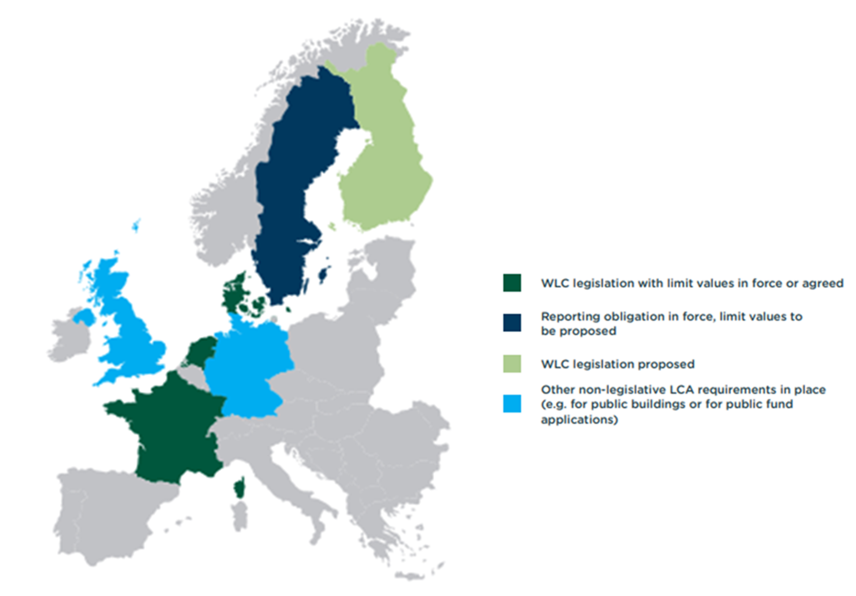
Source: [3]
What’s the best way to incorporate embodied carbon in UK Building Regs?
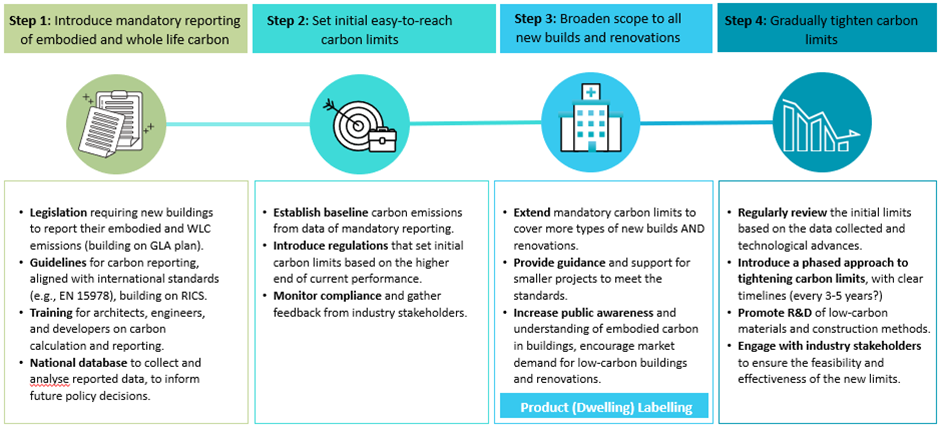
Quantifying embodied carbon is hard, and will be new for many people in construction. There is a learning curve, and there remain multiple tools and multiple databases of embodied carbon emissions for different products. We cannot force the industry to change overnight, so we advocate a staged approach – see figure below.
However, apart from the three UK local authorities that require developers to report embodied carbon (the Greater London Authority, the West Midlands, and Brighton & Hove) the UK has prevaricated for too long. If it was our decision, as Step 0, the Government would state clearly tomorrow that developers will have to report embodied carbon for all new buildings from 1 August 2025.
Our suggestion is consistent with the UK Green Building Council, the Institute of Structural Engineers, and other industry bodies’ recommendation of a new Part Z [4] in the Building Regs, which will cover embodied carbon – although our hope is that it can be rolled out faster than that.
Our Step 1 requires developers to start quantifying embodied carbon emissions in their schemes, and reporting the figures to MHCLG so it can build up data for a clear picture of current embodied carbon in new buildings. Step 2 uses this data to set easy-to-reach targets where only schemes with unusually high embodied carbon per square metre will need to change the way they build. Initially we see this applying to homes and buildings over 100m2 (a low threshold) so that smaller, low-cost housing is unaffected by the regulation.
Step 3 would broaden the scope of the legislation so it applies to retrofit work as well as new build, and also applies to smaller homes. It would include support to smaller construction firms so they learn how to measure, manage and reduce embodied carbon in their projects. It would also raise public awareness of embodied carbon – critically by introducing Eco-labelling for embodied carbon in new homes. A simple A to G rating would mean home-buyers and others would be able to make informed decisions about property purchasers without engaging with the complexity of embodied carbon. It would also make it easier for house-builders to justify spending on embodied carbon, in order to sell a premium product with low-embodied carbon.
Finally, Step 4 would gradually tighten the targets so developers have to do more to reduce embodied carbon emissions. Again, this would be informed by the National Database of embodied carbon established in Step 1, and by consultation with industry stakeholders.
Staged approach to introducing Embodied Carbon in UK Regulations
What did MHCLG make of this?
The Ministry welcomed our suggestions. They explained that they have been actively considering embodied carbon in construction for at least three years, and they are monitoring activities by RICS, the GLA, the lobby for a new Part Z, and other calls to address embodied carbon. However, they emphasised that new legislation on embodied carbon is likely to bring costs for construction, and that under the new Labour government the Ministry is very focused on increasing the supply of new housing. They felt that new regulations must not put meeting housebuilding targets at risk, and they acknowledged that there is a tension between this and addressing the climate emergency.
They recognised that the Ministry holds a critical lever in encouraging the construction industry to reduce embodied carbon. But they are also aware of multiple balancing acts relating to new regulations: increasing costs and workload of the construction supply chain vs. reducing overall carbon emissions, achieving consistency in emissions targets between sectors vs. reflecting diversity among buildings, and maximising the impact of any Regs with broad sectoral/size coverage vs. focusing on the most experienced/largest developers and developments. The French philosopher and writer Voltaire had an aphorism (a ‘pithy observation containing a general truth’) about this – he said: “The Best is the Enemy of the Good”.
MHCLG also noted that there are still unanswered questions about how the carbon savings that could be achieved from regulating embodied carbon relate to savings already achieved from other policy instruments – like DEFRA’s Timber Construction Roadmap, published at the end of last year, and which will also steer the industry towards lower embodied carbon.
Streamlining planning to accelerate housing supply and boost annual house completions will inevitably increase embodied carbon emissions from construction. As UK suppliers can no longer meet demand, it will also prompt dramatic rises in construction materials imported from overseas – often with larger carbon footprints. Just as important, the current trajectory of decarbonising heating by substituting gas and oil boilers with heat pumps means that embodied carbon is likely to dominate over in-use carbon. Whereas traditional homes with fossil fuel heating have high operational emissions, energy-efficient homes with heat pumps have far lower in-use emissions.
Our view is we have run out of time to continue thinking about regulating embodied carbon. The Green Building Council has been pushing for government intervention since 2017 at least [5]. We have offered MHCLG a staged approach for doing this and they need to act now to confront the blind spot. Listen to Voltaire.
References
[1] https://www.legislation.gov.uk/uksi/1965/1373/pdfs/uksi_19651373_en.pdf
[2] Passivhaus Trust (2022) Passivhaus and embodied carbon. London: Passivhaus Trust.
https://www.passivhaustrust.org.uk/UserFiles/File/Policy%20papers/2022.04.25%20Embodied%20Carbon%20full%20paper%20v1.3%20Patrons.pdf
[3] Steinmann, J., Rock, M., Lutzkendorf, T., Allacker, K., & Le Den, X. (2022). Whole life carbon models for the EU27 to bring down embodied carbon emissions from new buildings. Review of existing national legislative measures.
https://7520151.fs1.hubspotusercontent-na1.net/hubfs/7520151/RMC/Content/Whole-life-carbon-models-Review-of-national-legislative-measures.pdf
[5] https://ukgbc.org/wp-content/uploads/2017/09/UK-GBC-EC-Developing-Client-Brief.pdf