
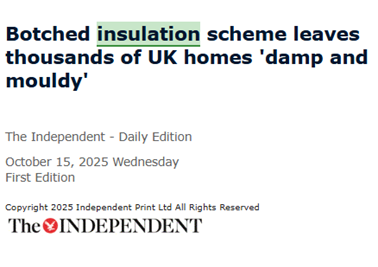
Monday and Tuesday’s reports in the media of the National Audit Office’s investigation of solid-wall insulation were concerning, but also misleading and partial, exaggerating problems with internal and external wall insulation installed in UK homes. The negative coverage risks deterring people from insulating the UK’s 8.5 million solid-wall homes. Without insulating these homes properly we will fail to meet targeted cuts in greenhouse gas emissions that are needed to address climate change. Failing to insulate these homes also has major implications for the roll-out of heat pumps, resident comfort, and affordability. Without insulating these homes (predominantly pre-1920 homes) the running costs of heat pumps also will be much higher than they are currently, using gas.
It is perfectly true that solid-wall insulation (both internal wall insulation, IWI, and external wall insulation, EWI) are ‘high risk’ retrofit measures, since poor-quality installs can have major – sometimes catastrophic – outcomes. This is a problem the energy-research community has known about for a long time – extending back at least as far as Tim Forman’s PhD on solid wall insulation installation practices, published in 2015. Even then, Tim showed [1] there was a massive problem being stored up. He found “Numerous examples of problematic practice in installation.”
In Tim’s words, back in 2010-2015, “In many ways, the industry repeatedly failed to improve practice. This, however, appears largely due to inadequate training, support and structure. To a great extent, prior failures have been ‘sins of omission, not of commission’… the system of delivery must be optimised in order to reach targets without raising detrimental impacts.”
Tim also articulated the perspective of government agencies and others working in the field at the time, that solid-wall insulation (SWI) is far too important to omit from Government retrofit schemes, even though it is expensive and carries risks: “The potential benefit realised from improvements [resulting from SWI] should incentivise all actors to commit to getting things right. Whether measured as life cycle or capital cost, environmental or social benefit, opportunities for training and stimulation of local economies – whatever the externalities may be – the cost impacts at stake have sizeable implications across society.” Tim might have got a little carried away with his closure to this paragraph: “It is not hyperbolic to state that every individual will be affected by the success or failure of SWI rollout.” But on other points Tim’s PhD was on the money.
Other research has reached similar conclusions, pointing the finger at the insulation of unsuitable properties or without following best practice [2], incorrect specification, detailing and installation [3], and weaknesses in training [4]. Virginia Gori et al, the last of these sources, draws special attention to unintended consequences of SWI, especially linked to moisture, and says we need better training for installers to help turn this around.
NAO figures are exaggerated
The National Audit Office report [5] dwells mainly on ECO4 (the current round of the Energy Company Obligation, which requires energy suppliers to invest in energy-efficiency measures in fuel-poor households, including SWI), and Great British Insulation Scheme (GBIS, which is Government funding for households receiving benefits or on low incomes, or modest homes with low Energy Performance Certificate ratings: D to G ratings).
The National Audit Office notes that ECO4 is expected to deliver £280 million in energy bill savings every year. That’s a lot of energy and carbon emissions: good news for the environment, and good news for the households benefitting, with these households saving up to £450 a year each on energy bills.
GBIS is smaller, but energy suppliers are still expected to save close to £56 million a year in energy bills, and up to £230 for every household that participates.
For both schemes combined, Ofgem says there were 28,000 EWI installs and 45,200 IWI installations to the end of March this year. 60,000 of these were funded through ECO4 and GBIS. DESNZ wrote to all of them at the start of this year informing them about issues with solid-wall insulation. However, only 5,900 of these households responded to DESNZ by August this year about the issue – suggesting that only 10% of the households themselves thought they had any problem with their insulation. (It is possible some may have independently spoken to their energy supplier or installer to sort out issues, or that problems have not yet manifested.)
The NAO report states that “DESNZ and Ofgem believe that nearly all external wall insulation and around a third of internal wall insulation fitted under ECO4 and GBIS have major issues requiring remediation”. We believe this is stated too strongly, and mis-interprets the shortfall in meeting PAS2035 (a British Standards framework for energy retrofits, promoting a ‘whole house’ approach). Failing to achieve PAS2035 does not necessarily mean that remediation is necessary. In fact there are large numbers (far more than NAO’s 2% figure) of successful EWI schemes around the country where residents are happy with the insulation, saving money, and reducing energy use and emissions every year [6].
In addition, deeper into the NAO report but un-reported in media coverage of this investigation, the NAO provides comparison figures from two other sources of Government funding for solid-wall insulation: the Social Housing Decarbonisation Fund (SHDF) and the Home Upgrade Grant (HUG). These have far lower reports of issues requiring remediation: 12% for EWI and 10% for IWI. Even these figures are worrying, and we need to do better, but this shows that even at volume, solid-wall insulation can be installed well, with modest risk contractors will be called back to address problems.
It is quite true that solid-wall insulation has the potential to go wrong if there is “shoddy work” (NAO’s term), if installers have inadequate experience, and/or they sub-contract the work to inappropriate third parties. Rather like roof repairs, poor workmanship or cutting corners (on IWI or EWI) can be catastrophic and result in very high remediation costs.
However, this is no reason to abandon solid-wall insulation – just as it is no reason to abandon roof repairs.
Jason’s letter to the Guardian on this subject was published on 26th October 2025:
No reason to abandon external wall insulation | Energy efficiency | The Guardian
[1] Forman, T (2015) Practice, policy and professional roles: unintended consequences and performance gaps in UK domestic solid wall insulation retrofit projects. PhD Thesis, Cardiff University.
https://orca.cardiff.ac.uk/id/eprint/92477/
[2] BRE (2016). Post installation performance of cavity wall and external wall insulation. Constructing Excellence in Wales. Cardiff: BRE.
http://www.cewales.org.uk/files/3014/7671/0110/Post_Installation_Performance_of_Cavity_Wall__External_Wall_Insulation.pdf
[3] Hansford, P (2015) Solid Wall Insulation: Unlocking demand and driving up standards. 2015 https://assets.publishing.service.gov.uk/media/5a74ebf540f0b65f61323554/BIS-15-562-solid-wall-insulation-report.pdf
[4] Gori, V, Marincioni, V, Altamirano-Medina, H (2021) Retrofitting traditional buildings: a risk-management framework integrating energy and moisture. Buildings & Cities 2(1) pp411-424.
https://journal-buildingscities.org/articles/10.5334/bc.107
[5] National Audit Office (2025) Energy efficiency installations under the Energy Company Obligation. London: NAO/House of Commons.
https://www.nao.org.uk/reports/energy-efficiency-installations-under-the-energy-company-obligation/#downloads
[6] Glew, D et al. (2024) DEEP Report 1: Synthesis Demonstration of Energy Efficiency Potential. Leeds: Leeds Beckett University.
https://assets.publishing.service.gov.uk/media/671f61e4ae0462c448fc4074/1._DEEP_Synthesis_Report.pdf